Old Rubbers, Wet Doors: Why Your Golf MK2 Seals Let Water In
- an October 16, 2026
- Categories: Database
Run your finger along the outer window scraper on a Golf MK2 that still wears its original rubbers. Chances are it feels more like plastic than rubber. Look at the ends, too: on a lot of cars the scraper no longer reaches the end of the door. That little gap is where the trouble starts.
This guide covers every rubber that keeps water out of a MK2 (window scrapers, door seals, window rubbers and roof rubbers), what happens when they age, and what to replace first.
In this article
Why 35-year-old rubber stops sealing
The youngest MK2 Golf is now over 30 years old. Its seals have spent all that time in sun, rain and frost. Rubber doesn't like that.
Sunlight is the main enemy. UV light breaks the bonds in the rubber and the exposed seals on doors, windows and boot lids slowly change colour and crack, as research on EPDM sealing profiles describes. Plain exposure to the air does the rest: weatherstripping simply gets harder over time. A quick test any restorer uses: squeeze the rubber. If it doesn't spring back, it has lost its pliability and won't seal anymore.
Hollow seals have a second problem. After years of being squashed by a closed door they stay flat (people call this collapsing), so even a seal that still looks fine can leave a gap.
Here's the thing about old seals. They rarely fail all at once. A drip here, a damp carpet there, more wind noise on the motorway. By the time you notice, the water has often been getting in for years.
Window scrapers: the small strip that rots your doors
The outer window scraper (VW part number 193 839 477 B) sits along the top edge of the door skin, against the outside of the glass. Its job is simple: wipe the window as it goes down and keep rainwater from running into the door.
On old cars, two things happen to it:
- It hardens. Years in the sun turn the soft lip into a stiff strip that no longer presses against the glass.
- It shrinks. The scraper gets shorter, leaving a gap between the rubber and the end of the door.
- It cracks. Once brittle, the lip splits and pieces break off.
- And sometimes it's simply been half missing since the nineties.
Water now runs down the glass straight into the door. A door is built to cope with some water: it is designed to channel it downward and out through the drain holes in the bottom. But more water means more wet time inside the door, and if those drain holes are blocked with dirt, it sits there. The result is the classic MK2 problem: rust on the lower edge of the door, working from the inside out. Heritage Parts Centre lists door bottoms among the known MK2 rust spots, and by the time you see bubbles on the outside, the inside is usually worse.
Finding good used originals is close to impossible. Most original scrapers we come across are hard and shorter than they should be, which is why we stock new ones:
- → Window scraper rubber set for 5 door (all four doors; fits Golf and Jetta MK2, old and new type)
- → Window scraper rubber set 3 door CE1 (old type), for the old-type doors with the triangle glass and the mirror not in the corner
- → Single scrapers per door: front left, front right, rear left, rear right
Two honest fitting notes. They may need a small bit of trimming for a perfect fit. And they are not compatible with the chrome window trims, because those trims need special cut-outs.
Why wet doors also kill your door cards
Rust isn't the only damage. The MK2 door card is built on a pressed wood-fibre board, a hardboard-type material, with the vinyl or cloth glued on top. That board doesn't like water at all. Once it gets wet it softens, swells and warps, usually starting at the bottom edge where water collects. The clips pull out of the soggy board and the card starts to hang loose from the door.
Behind the card, the door should have a plastic membrane: a sheet that keeps water inside the door away from the card. On many old cars that sheet is torn, half missing or was never put back after a repair. With a leaky scraper and no membrane, the card gets soaked every time it rains.


So when you replace your scrapers, take the door card off and check three things while you're in there:
- Is the plastic membrane intact and sealed around the edges?
- Are the drain holes in the bottom of the door clear?
- Is there surface rust inside the door bottom you can treat now, before it comes through?
If you're making new door card boards yourself, restorers commonly seal the board (with watered-down PVA or varnish) before covering it, so it survives a bit of moisture better than the original did.
Door seals: the rubber on the body
The big door seal runs around the door opening on the body. When it hardens or collapses, you get the familiar MK2 combination of wind noise at speed and water drips on the sill or carpet after heavy rain.
A seal that has collapsed but is still soft can sometimes be revived. One trick is to push a thin tube into the hollow part of the seal to lift the sealing surface again. Silicone rubbed into dry rubber can restore some flexibility, too. Once the rubber is brittle, though, nothing brings it back. Replace it.
On the inside, the black plastic trim strips that sit over the door seal also tend to fade, crack or go missing. For 4-door cars we have a new interior door rubber seal trim set and the matching trim clips (since the set comes without these trim clips).
Windscreen and rear window rubbers
Most MK2s have their windscreen held in a rubber seal. When that seal hardens and shrinks, water creeps in behind it. Two places suffer: the area under the windscreen, where rust bubbles appear under the seal, and the front carpets, which get wet after heavy rain. Heritage Parts Centre puts it well: just like an iceberg, the rust under the windscreen seal is usually twice as bad below the surface.
Worth knowing before you order anything: not every MK2 has a rubber-mounted screen. The G60, the Golf Rallye and US-spec MK2 Golfs have a bonded windscreen, so a standard rubber windscreen seal won't fit those.
Replacing a windscreen seal means taking the glass out, and most people let a glass specialist do it. If you're doing a respray or rust repair around the screen anyway, that's the moment to fit a new seal.
Roof gutter rubbers
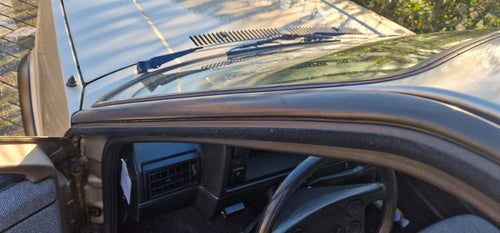
The roof gutter rubbers on top of the MK2 are probably the most-replaced rubber on the car. Old ones go hard, break and let water run where it shouldn't, with wind noise as a bonus. It's also one of the parts we developed in-house: the Roof Gutter Rubber Replacement Kit. You cut off the old rubber and fit the new one with the included tools, glue and clips. It fits 3- and 5-door Golf and Jetta MK2. Missing clips? There's a 10-piece roof gutter clip set too.
We wrote a full article on this one: Golf MK2 roof gutter rubber: skip the full replacement, just fix the rubber.
The small rubbers people forget
Some leaks come from parts that cost less than a coffee. Check these while you're going over the car:
- Tail light seals sit behind the rear lights. A dried-out one lets water into the boot. We have used OEM ones for the left and right side.
- Door handle rubbers go between the exterior handle and the door: small and big.
- Mirror rubbers behind the CE2 side mirrors: left and right.
- Sunroof drains, if your car has a sunroof. Not a rubber, but a blocked drain gives exactly the same wet carpet.
Where to start
If you only fix one thing this winter, do the window scrapers. They're cheap compared to a new door bottom, they bolt on (well, clip on) in an afternoon, and they protect both the metal and the door cards. Pop the door card off while you're there and check the membrane and drain holes.
Then work through the list by symptom: wind noise → door seals; wet front carpet → windscreen seal or the area under it; water along the roof → roof gutter rubbers; damp boot → tail light seals. Old rubber won't get any better. The rust behind it only gets worse.
FAQ
How do I know if my Golf MK2 window scrapers need replacing?
Squeeze the rubber lip. If it's hard and doesn't spring back, it no longer seals against the glass. Also look at the ends: original scrapers often shrink, leaving a gap at the end of the door. Cracks, missing pieces and water running inside the door when you wash the car are other clear signs. On most MK2s that still have their original scrapers, at least one of these is true.
Can leaking window scrapers cause rust in the doors?
Yes. Worn scrapers let rainwater run down the glass into the door. A door is designed to drain water through holes in the bottom, but extra water, and blocked drain holes, keep the inside of the door wet. That is how the lower edge of MK2 doors rusts from the inside out. New scrapers, clear drain holes and treating surface rust early are the cheapest way to prevent a door bottom repair.
Why are my Golf MK2 door cards warped at the bottom?
The door cards are built on a pressed wood-fibre board. When water gets into the door and the plastic membrane behind the card is torn or missing, the board soaks up moisture, swells and warps, usually from the bottom edge. The clips then pull out and the card hangs loose. Fix the water source first (often the window scrapers), then replace the membrane and the card.
Do Golf MK2 window scrapers fit the Jetta MK2?
Yes. Our 5-door scraper set (part number 193 839 477 B) fits Golf and Jetta MK2 with both the old and new type doors. Old-type 3-door cars (with the triangle glass and the mirror not in the corner) use the two front scrapers from the 5-door set. The scrapers are not compatible with the chrome window trims, and they may need a little trimming for a perfect fit.
Does every Golf MK2 have a rubber windscreen seal?
No. Most MK2 Golfs and Jettas have a windscreen mounted in a rubber seal, but the G60, the Golf Rallye and US-spec MK2 Golfs have a bonded windscreen. A standard rubber windscreen seal won't fit those cars, so check your model before ordering.
Not sure which scraper or seal fits your car? Send us a message with your model and year, or browse all our parts.
Sources: Düzce University Journal of Science and Technology, UV aging of EPDM automotive sealing profiles (2018); OPGI, Top Tech Tips: Weatherstripping; Counterman, Weatherstrip Care and Repair; Heritage Parts Centre, Where does a Golf Mk2 rust?; Heritage Parts Centre, Golf Mk2 windscreen seal 191 845 121 product information; Club 80-90 forum threads on door card base material and door water ingress; carwiki.de, VW Golf 2: Wasser im Fußraum; Golf MK2 Parts product information.
Über den Autor